
There's a story about the fearsome challenges of unaccompanied performance accredited to the late guitarist Joe Pass. You settle yourself down in the spotlight, position your watch, play a sublime first number that seems to say everything you ever wanted to say - and find that only two minutes have gone by. But Sunday's gig featuring solo sets by the sax-and-loops specialist Terry Edwards and the celebrated New York guitarist Marc Ribot suggested both performers had plenty they wanted to get off their chests.
Brass and reeds improviser Edwards was up first, with an intriguing sideshow of an act. He played a pretty weird choice of theme statements in a dignified manner over backing tapes of rock, funk and noise, often sounding like a busker in a busy street. Boys and Girls Come Out to Play appeared in a slow, raw-edged alto-sax incantation, over rattling chains, tinkling music boxes and clanging metal sounds. He delivered an atmospheric Harlem Nocturne, and wound up with Thelonious Monk's Well You Needn't as a broad-toned alto wail over a dragging backdrop heaving with rock guitars.
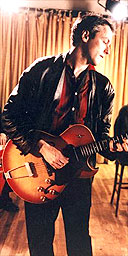
Ribot, by contrast, came up with a surprising and rather satisfying quantity of skewed electric blues and Django Reinhardt-like acoustic balladeering. In between, he hurled in his familiar repertoire of slurred, floundering chords, war-zone thunderings, Derek Bailey-like harmonics and behind-the-bridge scurryings. Ribot absorbingly joins Bailey's abstract improv with Bill Frisell's lurching chordal plasticity and very early traditions of acoustic swing and blues guitar. It's never clear whether he will choose to cherish or deconstruct a familiar theme, and that is one of the pleasures of hearing him.
I Surrender, Dear was an angular, fragmented reappraisal. Albert Ayler's poignant Ghosts emerged with the modestly moving melody left almost untouched. No 17, from John Zorn's Book of Heads, was a furore of pounding train rhythms, ascending spirals of noise and writhing runs. Ribot certainly didn't perform as if the motion of his watch seemed slow to him, and for the most part the audience were ready to stay put and listen.
