
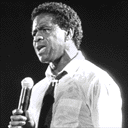
Take Me to the River
Al Green, with Davin Seay
Payback, £14.99, 343pp
Buy it at a discount at BOL
Reading the rock biography, one might argue, is probably the closest most of us come these days to reading the Greek myths. Indeed, in her recent, brilliant and completely bonkers book I'm a Man , the poet Ruth Padel makes that very claim, in mind-blown prose: "It was ultimately Greek mythic ideals of relationship, quest, triumph and danger, of exploring self through impersonating other people, which powered this sci-fi mix of ancient and primitive, male and female, ultra-sophisticated electronics and crazed rawness, violence and darkness, all this theatrical dream of being male, in our time."
Padel has a lot of interesting things to say about rock and gods, but almost nothing to say about rock and the good old-fashioned monotheistic God to whom many of the great rock and pop musicians of the 20th century paid lip-service. Al Green's extraordinary testimonial, Take Me to the River , puts God the Father back at centre stage: "God has prepared Al Green for such a day as this, when I will lift my voice like the prophets of old to reveal His glory."
The Reverend Al Green can be found serving God's glory these days at his church in Memphis, Tennessee, and also in his appearances in Ally McBeal , which he graces white-suited and with full gospel choir to serenade the eponymous heroine in her gradual descent into lip-syncing madness. But there was a period in the early 1970s, with "Tired of Being Alone", "Let's Stay Together", "I'm Still in Love With You", "Call Me (Come Back Home)" and "Here I Am (Come and Take Me)", when Green was serving the Lord with some of the sweetest soul music ever to come out of the American south.
Born into a sharecropping family in Arkansas in 1946, one of 10 children, Green started his singing career in church with his father and brothers as the Greene (sic) Brothers. After the family made the move north to Michigan and his father had thrown him out for playing Jackie Wilson's "A Woman, A Lover, A Friend" too often and too loudly, Green formed the Creations with Curtis Rogers and Palmer Jones, and they had their first and only hit as Al Greene and the Soul Mates in 1967 with "Back Up Train".
It wasn't until Green went solo and teamed up with the legendary Willie Mitchell - band leader, producer and impresario - that he discovered his own unique style. Mitchell recognised what Green calls a "surrendering feeling" in his voice, and encouraged him to write his own material. What distinguishes both Green's delivery and his lyric writing to this day is its beguiling lack of force: there's no shouting, nor any of that horrible soothing that you get in a lot of soul and R&B. It's not sentimental; it's genuinely sad. Of all the great soul voices, Green's perhaps expresses the greatest vulnerability. It's a voice seeking recognition.
At first, there came no response. Green Is Blues , Green's first solo album, was released in the summer of 1969, but the first three singles from the album were a flop. Singles from the next album, Al Green Gets Next to You , didn't fare much better. The breakthrough came with the solid, chugging "Can't Get Next to You", and then, with increasing degrees of subtlety, "Tired of Being Alone", "Let's Stay Together" and "Love and Happiness". This early Hi Records sound isn't Stax, Motown or Atlantic - it's much smoother, with the drums high in the mix and the famous brothers Hodges creating the perfect rich complement to Green's apparent soft-spoken simplicity. You never get the feeling that he's having to fight the band. It's all obbligato .
And also a winning of formula rather than just a winning formula: where Percy Sledge had gone before, trailblazing in 1966 with "When a Man Loves a Woman", the first big R&B/pop crossover, Green followed, but in his own way and with a sound that appealed to black and white alike. With the release in 1974 of his seventh album, Al Green Explores Your Mind , Green looked set to consolidate his success. He was, as he says, "in the groove". He was also enjoying the considerable privileges - of every kind - to which a man of his celebrity feels entitled. "Did I sin and then sin again," Green asks, "with no thought to the consequences or the great and sure judgment I was bringing down upon myself?" You bet he did.
Then in October 1974 everything changed. As legend and The Virgin Encyclopedia of R&B and Soul has it, "Following an argument, his girlfriend, Mary Woodson, burst in while the singer was taking a bath and poured boiling grits over his back . . . a scarred and shaken Green vowed to devote more time to God." Green's version in Take Me to the River runs rather differently. Mary Woodson wasn't his girlfriend: she was one of several. And he wasn't in the bath: he was brushing his teeth. And he'd already been devoting more time to God since being born again and starting to speak in tongues in a hotel room in Anaheim, California, back in 1973. Whatever the details, the consequences are pretty much the same. Green sustained third- degree burns, and Woodson shot herself. If anything, Green now achieved an even greater, diabolical fame. The hits kept coming - "L-O-V-E (Love)" and "Full of Fire", both in 1975 - but something had come apart.
In Take Me to the River Green attempts to pick up the pieces. "Introducing the real Al Green," he says, "is like introducing three different people, each one with his own point of view and each one with his own side of the story. And more often than not, they're all fighting with each other." These three Al Greens are, for reference, "Al Green, the Last Great Soul Man; Al Green, the Country Preacher with the common touch; and Al Green, the family man". The book is remarkable not for its candour or clarity, but because of these deep confusions, because it depicts a divided mind and tells the story of Green's seeking a wholeness that is not there to be had. This is also, one suspects, why people still listen to his songs. And incidentally, in case you were worrying, it's probably why you watch Ally McBeal .
